Monica N. Sheets
Treasurer
Honoring Troy Anthony Haynes Jr. by raising awareness of renal medullary carcinoma and investing in young people and our community.

Troy Anthony Haynes Jr. was so much more than a football player—and so much more than his diagnosis.
Troy was a son, brother, scholar-athlete, teammate, friend, and young man who was deeply loved by his family and community. He had a smile that could light up a room and a heart that was just as big.
At Woodbridge High School, Troy worked hard both in the classroom and on the field. He was an honor-roll student and a talented three-sport athlete who excelled in football, basketball, and baseball.
Football became one of the places where Troy truly shined. As a four-year starting quarterback, he helped lead Woodbridge to state championships in 2016 and 2018.
But Troy wasn’t finished.
After high school, an exciting new chapter was waiting for him. Troy had been accepted to the University of Mount Union and was preparing to leave home, continue his education, and play quarterback at the collegiate level.
He had dreams. He had plans. He had worked for his future.
Then, in April 2019, at just 18 years old and only weeks before his high-school graduation, everything changed.
Troy was diagnosed with Renal Medullary Carcinoma (RMC), a rare and highly aggressive form of kidney cancer strongly associated with sickle cell trait.
Cancer changed Troy’s plans.
But cancer never changed Troy.
Through surgeries, treatments, clinical trials, hospital stays, pain, and uncertainty, Troy continued to show the same strength, love, and compassion that had always been part of who he was.
Even while facing something no 18-year-old should have to face, Troy was still thinking about someone else.
During an interview, Troy shared that he was glad this happened to him instead of his younger brother.
Those words say so much about the kind of young man Troy was.
Selfless.
Protective.
Loving.
Strong.
And through it all, Troy kept smiling.
Through the treatments.
Through the difficult days.
Through the uncertainty.
That big, unforgettable smile remained on his face right through his final day.
Troy still reached an important milestone he had worked so hard for—graduating from Woodbridge High School in June 2019.
On September 22, 2019, Troy celebrated his 19th birthday.
Just seven days later, on September 29, 2019, Troy passed away.
But that is not where Troy’s story ends.
Troy will forever be loved and missed by his mother, father, siblings, family, friends, teammates, coaches, classmates, and the community that embraced him.
His courage continues to inspire.
His smile is still remembered.
His story is still being told.
And his life continues to make a difference.
In January 2020, Troy’s parents, Troy Haynes Sr. and Christina Haynes, founded the 4Troy Foundation to ensure that their son’s story would become a source of Education • Awareness • Advocacy for others.
Today, every conversation about RMC, every person who learns their sickle cell trait status, every family who learns the warning signs, and every community reached through 4Troy helps carry Troy’s legacy forward.
Troy was more than RMC.
He lived. He loved. He achieved. He inspired.
TROY LIVES ON.
AND WE WILL FOREVER FIGHT LIKE 4. 🧡
A collection of moments that celebrate Troy’s life, talent, family, and legacy.
I do not own the rights to this music

President
Executive Director

Treasurer

Secretary
Renal medullary carcinoma (RMC) is a very rare and aggressive cancer that starts in the inner part of a kidney. Aggressive means it can grow and spread quickly. RMC is seen most often in teens and young adults. RMC is strongly linked to sickle cell trait, but having the trait does not mean a person will develop this cancer.
Sickle cell trait is an inherited blood condition. RMC is a very rare and aggressive kidney cancer. They are different conditions, but people with sickle cell trait have a higher risk of RMC. RMC is still extremely rare, and most people with the trait will never develop it. If you do not know your trait status, ask a healthcare provider about hemoglobin electrophoresis, a blood test that checks which types of hemoglobin you have.
Blood in the urine is the most common sign of RMC. Other possible signs include a lump in the abdomen, fever or night sweats, pain near a kidney or in the side or back, fatigue, and unexplained weight loss. These symptoms can have many causes, but they should be checked.
Contact a healthcare provider promptly, especially if you see blood in your urine, even once. Tell them if you have sickle cell trait or do not know your status. Ask what evaluation is appropriate for you.
This information is for education and does not replace medical care. Sources: National Cancer Institute’s RMC guide ↗ and CDC sickle cell trait guide ↗, and MD Anderson’s explanation of the connection ↗.
Sickle cell trait and renal medullary carcinoma (RMC) are different conditions. Sickle cell trait means a person inherited one usual hemoglobin gene and one sickle hemoglobin gene. RMC is a very rare and aggressive kidney cancer. Most reported RMC cases involve sickle cell trait, but RMC can also occur in people with sickle cell disease. Having either condition does not mean someone will develop RMC.
Campaign and research visuals are illustrations, not photographs of 4Troy events or medical staff.
Sickle cell trait means inheriting one usual hemoglobin gene (A) and one sickle hemoglobin gene (S). Sickle cell disease involves two genes that make abnormal hemoglobin, such as HbSS or HbSC, and can cause serious health problems.
To learn your status, ask a healthcare professional about hemoglobin electrophoresis, a blood test that identifies hemoglobin types. You can also ask whether your newborn screening result is available.
RMC is a rare, aggressive cancer of the kidney’s inner region, called the medulla. Most reported cases involve sickle cell trait (HbAS). It can also occur with sickle cell disease, including HbSS and HbSC. Most people with these conditions will never develop RMC.
The medulla has low oxygen and other conditions that can make red blood cells sickle. Researchers are studying whether repeated tissue injury there contributes to RMC and changes involving a gene called SMARCB1 and its INI1 protein. This is a developing explanation, not a proven sequence for every patient.
Knowing your trait status matters, but having sickle cell trait does not mean you need routine RMC screening. Discuss your own questions and symptoms with a healthcare professional.
Troy Anthony Haynes Jr. was an athlete and received care at MD Anderson Cancer Center. His treatment team included Dr. Pavlos Msaouel, an RMC physician-scientist who designed Troy’s clinical trial. We share this information to honor Troy and help athletes, families, coaches, and healthcare professionals recognize concerns early. It does not suggest that sports caused Troy’s cancer.
The inner kidney naturally has low oxygen and other conditions that can encourage red blood cells to sickle in someone with sickle cell trait. Very intense exertion and dehydration may add stress. Researchers are studying whether repeated injury there contributes to RMC and changes involving SMARCB1/INI1. This is a developing explanation, not a proven sequence for every case.
A carefully scoped observation: MD Anderson reports that about 60%–70% of the young Black men with sickle cell trait who developed RMC described in its explanation also had a history of high-intensity exercise. That figure is not a percentage of all people with RMC. It does not prove that exercise caused anyone’s cancer or establish an individual athlete’s risk. Dr. Msaouel and colleagues have studied the possible association in patients and experimental models.
Do not assume blood in the urine is “just training” or diagnose RMC yourself. A clinician can investigate the cause.
Having sickle cell trait does not mean an athlete must stop playing sports. To reduce exercise-related illness:
These precautions are for exercise-related illness. They have not been proven to prevent RMC. In the United States, RMC is seen more often in young Black people in part because sickle hemoglobin conditions are more common in that population; people of other backgrounds can also be affected.
Sources: MD Anderson and Dr. Pavlos Msaouel on RMC and exercise ↗ · Published RMC and exercise research ↗ · CDC guidance for athletes with sickle cell trait ↗
This information is for education, not a diagnosis or a personal training or treatment plan.
When cancer has spread: Symptoms depend on where it has spread and can include a persistent cough, chest pain, or bone pain. These symptoms do not automatically mean RMC.
Blood in the urine or side pain can also have other causes, including infection or kidney stones. Seek prompt medical evaluation, especially for visible blood in the urine, rather than trying to diagnose the cause yourself.
RMC is often advanced when found. Treatments used for more common kidney cancers may not work well for it. For most patients, an RMC-experienced team begins with chemotherapy and considers surgery later when appropriate. The plan depends on the person and the extent of the cancer.
Questions to ask the care team:
This toolkit is for education. It is not a diagnosis or a personal treatment plan.
Learn more from the National Cancer Institute’s RMC guide, CDC sickle cell trait information, and MD Anderson’s RMC information.
Our mission reaches from health education to opportunities that strengthen young people and communities.
Sharing understandable information about RMC and sickle cell trait, encouraging informed conversations, and amplifying the needs of affected families.
Supporting young people as they pursue education, leadership, and their goals, in the spirit of Troy’s determination and generosity.
Connecting neighbors with awareness efforts, health resources, and community partners through outreach and events.
Bringing people together to remember Troy, grow awareness, and turn community support into sustained action.
Moments from our awareness and community outreach efforts.
Milford High School · September 25, 2026


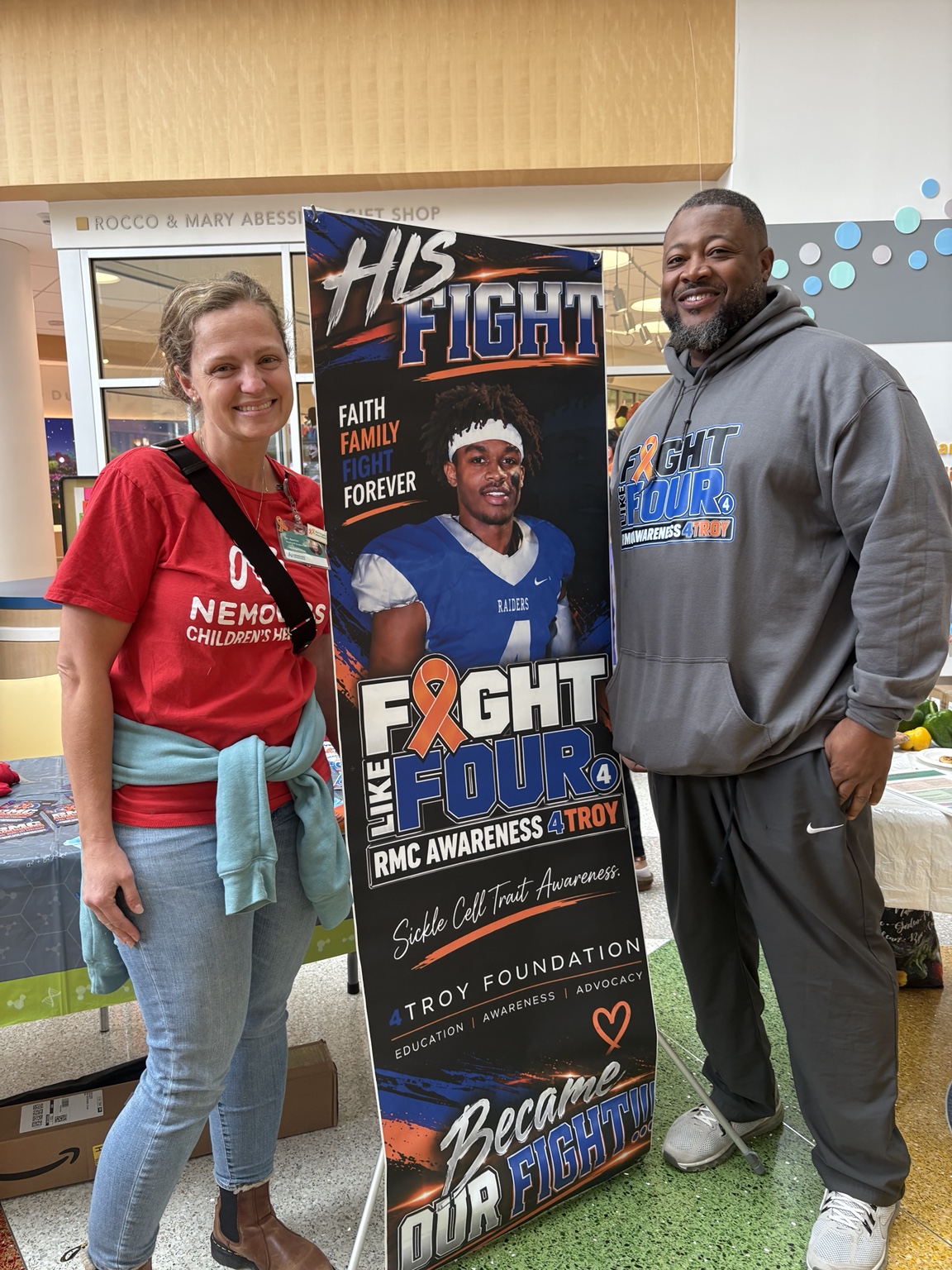
Nemours Children’s Hospital


Volunteer at an event, partner with us on education or outreach, sponsor a program, or help bring RMC information to your community.
We welcome conversations with families, schools, healthcare professionals, businesses, and community organizations.
Want to volunteer, partner, or share an opportunity? Reach out to the foundation and tell us how you would like to help.
Mailing address
4Troy Foundation, Inc.
P.O. Box 922
Greenwood, DE 19950
Phone
302-232-8621
Your support helps 4Troy advance RMC awareness and invest in young people and community programs. Choose the way you would like to give.
Scan this 4Troy Foundation QR code with the PayPal app to give.
If you are on your phone, display this page on another screen and scan the code with your PayPal app.
Mail a check or money order to:
4Troy Foundation, Inc.